

Committing your expansion budget to a rigid multi-year lease is one of the fastest ways to stall momentum. Between unpredictable hiring targets, weeks spent waiting on fit-out approvals, and heavy capital outlays for furniture, traditional commercial leases drain resources before new employees even begin work. Scaling a business with flexible office space changes this dynamic by linking real estate commitments directly to real-time headcount needs.
Forecasting team size twelve months in advance rarely matches reality, and running out of desks or paying for empty square meters hurts operational efficiency. This guide covers how to expand capacity, manage staffing swings, and protect liquid cash flow using adaptable commercial environments. You will learn practical strategies to move personnel into fully functional private offices and shared workspaces without downtime, while retaining full freedom to adjust your desk footprint as market demands shift.
Why Headcount Growth Breaks Traditional Commercial Leases
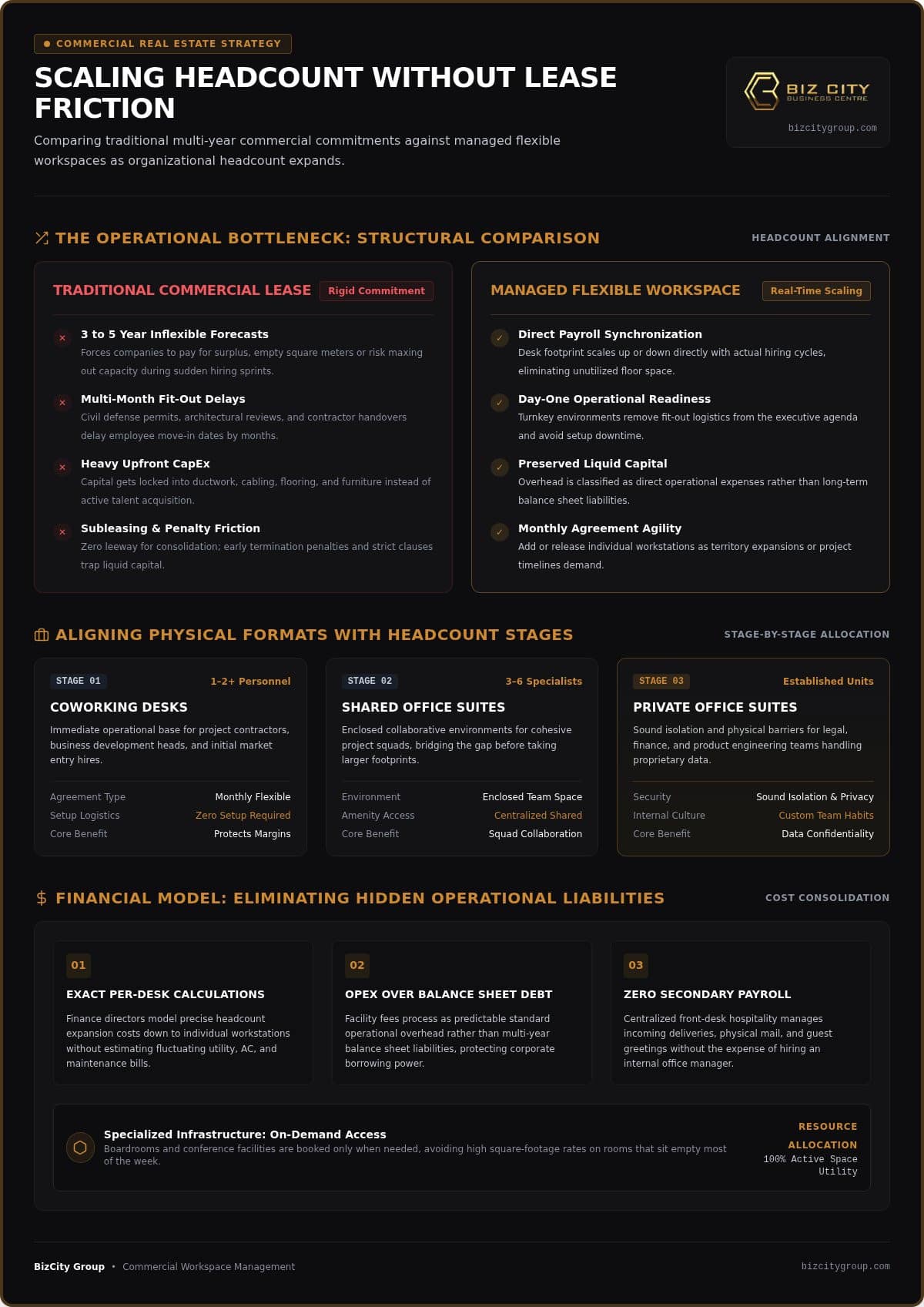
Conventional commercial real estate operates on an outdated premise: that an expanding company can accurately predict its desk count three to five years down the line. When teams expand quickly, conventional multi-year contracts become an operational bottleneck. Companies often lease surplus square footage to accommodate theoretical future hires, effectively paying rent on empty carpet for months at a time. Conversely, an unexpected hiring sprint can max out floor capacity within two quarters, triggering painful subleasing negotiations or forced relocations before the lease expires.
The Inefficiency of Forecasting Three Years Ahead
Projecting headcount beyond twelve months carries immense variance. Market shifts, client acquisitions, and new funding rounds rewrite hiring targets quickly. In a traditional lease structure, unoccupied desks sit on the income statement as pure operational waste. If market conditions shift and leadership must consolidate roles, standard commercial agreements offer zero leeway. Subleasing clauses carry steep administrative friction, and early termination penalties trap liquid capital when financial agility matters most. Scaling a business with flexible office space solves this friction by synchronizing square footage commitments directly with actual payroll cycles.
Fit-Out Delays and Capital Lock-Up
Beyond rigid contract terms, the physical setup of bare-shell commercial properties stifles expansion momentum. Securing civil defense permits, managing architectural reviews, and coordinating contractor handovers routinely stall move-in dates by several months. That delay prevents new personnel from collaborating effectively in person. Upfront capital expenditure on ductwork, flooring, furniture, and cabling pulls critical liquidity away from active hiring pipelines. Turning to modern, fully furnished environments such as serviced offices removes facility fit-outs from the executive agenda entirely, preserving cash reserves and keeping teams productive on day one.
Evaluating Workspace Formats Across Growth Stages
A growing company rarely moves in a straight line from two founders to fifty full-time employees. Expansion happens in stages, and each phase introduces distinct spatial demands. Growing an enterprise with adaptable commercial facilities works best when leadership aligns specific physical formats with current headcount milestones, avoiding the trap of committing to permanent floor space prematurely.
Coworking Desks for Agile Market Entry
When entering a new territory or launching an experimental business unit, hiring velocity is uncertain. Individual workstations in an open layout provide an immediate operational base for project contractors, business development heads, and initial hires. Teams skip setup logistics entirely, relying on centralized front-desk support, fast internet infrastructure, and utility management already in place. Monthly agreements mean managers can add or release individual seats as hiring plans shift, protecting operational margins while testing market traction.
As initial hires form cohesive project squads of three to six specialists, companies often transition into sharing offices. This intermediate format provides an enclosed, collaborative environment for a specific team while keeping common amenities shared, bridging the gap before taking on larger dedicated suites.
Private Suites for Established Operational Units
Once a department reaches critical mass, privacy and sound isolation become mandatory. Core functions like legal, finance, and product engineering handle proprietary data and sensitive conversations that require physical barriers. Fully enclosed private offices provide this containment while allowing companies to establish their own internal team habits within a managed facility.
Established teams also gain structured access to shared amenities that would otherwise require significant real estate investments. Instead of building out low-utilization square footage for occasional events, companies book fully equipped meeting rooms, larger conference rooms, and specialized facilities on demand. If your organization is planning its next stage of physical expansion, review the serviced workspaces at BizCity Group to match your current headcount with the right floor layout.
Financial and Operational Advantages Over Long-Term Commitments
Every commercial property carries hidden administrative weight that rarely appears on a standard lease summary. Setting up independent utilities, sourcing commercial internet connections, coordinating janitorial vendors, and managing HVAC maintenance contracts consume hours of operational capacity every week. Shifting these responsibilities to a managed facility eliminates operational distraction entirely. Instead of acting as property managers, company leaders can direct their attention straight toward product delivery, revenue acquisition, and talent retention.
Predictable Operational Budgeting
Conventional leases introduce volatile variable costs. AC repairs, electrical maintenance, waste management fees, and surprise building service charges disrupt cash projections throughout the year. Managed workspaces roll these costs into one predictable monthly line item.
This consolidation offers immediate financial benefits:
- Clear per-desk calculations: Finance directors can model exact headcount expansion costs down to the individual workstation without estimating fluctuating utility bills.
- Direct operational expense classification: Facility fees process as standard overhead rather than balance sheet liabilities, protecting borrowing power and corporate liquidity.
- Zero secondary payroll: Centralized front-desk hospitality manages incoming deliveries, physical mail, and guest greetings without the expense of hiring an internal office manager or receptionist.
On-Demand Specialized Infrastructure
Scaling companies often waste usable floor space on rooms they only use occasionally. Building an expansive twelve-person boardroom or a dedicated recording studio inside a traditional commercial footprint requires paying high square-footage rates for space that sits empty most of the week.
Turnkey environments resolve this operational inefficiency through shared high-spec infrastructure. When executive leadership hosts quarterly investor discussions or client negotiations, they can reserve dedicated conference rooms equipped with corporate-grade audiovisual hardware. Creative marketing and communication teams can book sound-treated podcast rooms for high-definition audio and video broadcasts, bypassing outside production studio rental fees entirely. By paying only for active operational hours rather than permanent square footage, businesses retain the functional reach of an enterprise headquarters on a lean budget.
How to Execute a Scalable Workspace Strategy
A successful transition away from static leases requires a clear assessment of how your staff actually works throughout the week. Signing a commercial agreement based on total payroll numbers almost always leads to overpaying for desks that sit empty on Mondays and Fridays. A measured deployment aligns physical capacity with real-time operational rhythms, ensuring your business stays agile without sacrificing professionalism.
Auditing Real Space Requirements
Start by tracking peak attendance rather than overall headcount. If a twenty-person product team alternates remote work days and never has more than twelve people on site simultaneously, you only need twelve dedicated positions alongside accessible breakout space. Next, map out departmental acoustics. Outbound sales representatives and client onboarding teams generate steady phone chatter that disrupts software developers and financial analysts. Partitioning your footprint into a mix of open coworking desks for collaborative staff and enclosed private offices for focus-heavy departments prevents daily friction while keeping operational overhead lean.
Selecting the Strategic Business Hub
Location directly influences your hiring pull and corporate reputation. Top-tier candidates routinely weigh commute friction when evaluating job offers, making transit connectivity a decisive hiring advantage. Securing an address directly linked to major transport arteries, such as proximity to metro stations along central corporate corridors, widens your talent pool across the entire metropolitan area.
The surrounding environment matters just as much for client-facing operations. Hosting international stakeholders in recognizable landmark towers establishes instant credibility without requiring millions in balance sheet assets. Easy access to hospitality venues, executive dining, and conference facilities ensures business meetings run smoothly from arrival to departure. When managing rapid team growth, make sure your workspace provider allows frictionless internal moves, letting you upgrade from a four-desk room to a twenty-desk corporate suite without terminating your primary contract. To establish your team in a prime commercial location with direct metro links, explore office solutions at BizCity Group.
Expanding Your Team Along Dubai’s Prime Commercial Corridor
Dubai’s commercial real estate market recorded an occupancy rate of approximately 94% in Q2 2026, creating genuine scarcity for well-located corporate space. In an environment where premium stock is tightly held, expanding companies cannot afford to compromise on location or spend months waiting on off-plan handovers. Positioning your workforce along Sheikh Zayed Road places your enterprise at the epicenter of regional commerce, giving you direct access to international financial networks and skilled talent pools.
The Advantage of Dubai World Trade Center and Sheikh Zayed Road
An address in landmark developments like Sheikh Rashid Tower or Trade Center 2 conveys institutional stability immediately. It signals financial strength to visiting partners and regional clients before conversations even begin. Beyond prestige, the practical day-to-day logistics are unmatched. Direct walking access to the Dubai World Trade Centre metro stations cuts daily commute friction for employees traveling from across the emirate. Surrounding hotels, financial institutions, and dining establishments make organizing formal client lunches or international board meetings effortless.
Scaling With BizCity Group Workspaces
Operating within this high-demand district does not require entering an inflexible commercial agreement. BizCity Group provides private offices, coworking areas, and sharing offices designed to accommodate enterprise transitions without operational disruption. Companies can place an initial market-entry team into dedicated workstations, add an adjoining sharing office as headcount expands, and eventually transition into an enclosed private office suite within the same property.
This layout adaptability keeps your organization agile while eliminating the friction of physical relocations. Teams maintain continuous business operations with full access to on-site amenities, including bookable meeting rooms, boardrooms, and dedicated podcast rooms for executive media production. Contact BizCity Group to view available office suites and secure your position along Dubai’s primary commercial corridor today.
Build an Agile Commercial Footprint Today
Sustainable corporate growth depends on financial discipline and operational velocity. Tying up capital in static commercial leases and lengthy interior fit-outs limits your ability to respond when hiring targets change. Successfully scaling a business with flexible office space turns corporate real estate into an operational advantage, giving your team immediate access to fully managed workstations while protecting critical capital reserves.
By establishing your company inside the Dubai World Trade Center corridor, you secure an influential commercial address directly connected to Sheikh Zayed Road metro links. Your staff and leadership gain immediate use of corporate infrastructure, from private offices and collaborative workstations to high-spec conference facilities and broadcast-ready podcast rooms. Schedule a private workspace tour at BizCity Group to discover how easily your workspace can adapt as your team continues to expand.
Frequently Asked Questions
How quickly can a team move into a flexible office space?
Teams can move into fully prepared spaces within 24 to 48 hours. Because enterprise infrastructure, commercial furniture, and high-speed network cabling are already in place, there is no waiting for interior permits or utility setups. Once the commercial agreement is finalized, staff can plug in their laptops and begin work immediately, bypassing the multi-month fit-out delays typical of traditional commercial property leases.
What is the difference between a private office and a sharing office?
A private office is an enclosed suite reserved entirely for a single organization, while a sharing office provides dedicated team desks within a shared, secure commercial layout. Private suites deliver total acoustic and operational privacy for confidential discussions and distinct team culture. Sharing offices let smaller teams collaborate in a dedicated zone while sharing facility overhead, creating a practical middle ground before taking on a larger executive suite.
Can a company upgrade to a larger office suite during the agreement term?
Yes, increasing your footprint is straightforward and does not involve breaking your lease. Operators like BizCity Group structure agreements to let expanding organizations move into larger private suites or add adjoining workstations within the same building. This operational flexibility prevents business downtime and spares your company the administrative headache and capital expense of moving across the city.
Are meeting rooms included with flexible office agreements?
Meeting spaces are generally accessible through monthly booking credits or direct on-demand reservations. Rather than paying ongoing lease rates for large conference areas that sit empty between sessions, companies reserve boardrooms only when client presentations or internal reviews demand them. Teams also gain access to specialized media environments, including broadcast-ready podcast rooms, without taking on studio equipment purchases or external production rentals.
How does flexible office space support hybrid working models?
Flexible workspaces let organizations pay only for desks their staff actively utilizes during the week. Managing a hybrid schedule often results in half-empty conventional floors on Mondays and Fridays. Using flexible contracts, companies can maintain a compact private office for core daily personnel and add bookable coworking desks on days when remote employees gather for quarterly reviews, strategic workshops, or all-hands department training sessions.
Why is metro accessibility important when choosing an office in Dubai?
Direct metro access significantly reduces daily commute friction and broadens your talent acquisition reach across Dubai. Choosing an address along Sheikh Zayed Road beside the Dubai World Trade Centre metro station allows employees and visiting partners to bypass peak highway traffic easily. Convenient transit links improve daily punctuality, expand recruitment pools across the emirate, and ensure international clients can reach your office without navigating unfamiliar traffic corridors.


