

The problems with meeting clients in cafes often begin when a convenient venue doesn’t support the conversation. Background noise, nearby tables and unexpected interruptions can make a client discussion difficult, especially when you need to cover confidential matters or make a strong first impression.
Cafés can still work well for informal introductions and relaxed catch-ups. The setting can feel welcoming, and refreshments are close at hand. But you may have little control over seating, how long you can stay or how easily others can overhear you. If the conversation needs focus, those limitations can leave both you and your guest uncomfortable.
The right venue depends on the purpose and sensitivity of the meeting. This guide explains where café meetings can fall short and how to choose a more suitable option without making the occasion feel overly formal. You’ll also compare practical alternatives in Dubai, including meeting rooms and conference rooms at BizCity Group locations in Dubai World Trade Center and on Sheikh Zayed Road, both near metro stations. With a setting that supports the conversation, you can focus on your client rather than the noise around you.
Why problems with meeting clients in cafes can arise
A convenient table doesn’t automatically make a workable meeting space. A café may suit a relaxed introduction, yet the same setting can make a detailed proposal harder to discuss. Music, nearby conversations, queues and staff moving through the space all compete for attention. Activity can also change by location and time of day, so a quiet visit earlier in the week doesn’t guarantee the same conditions during a busy lunch period.
That doesn’t make cafés inherently unprofessional. They can feel relaxed and welcoming, and the ‘third place’ concept helps explain their appeal as social settings between home and work. The key is fit. A little background activity may be a minor inconvenience during a brief catch-up. It matters more if it disrupts concentration, makes private details audible or leaves your guest struggling to take part comfortably.
The practical problems with meeting clients in cafes are limited control over sound, seating and interruptions. Consider what the conversation requires before confirming the venue. A short introductory chat has different needs from a discussion involving detailed figures, a proposal or sensitive business matters.
When background noise and interruptions affect the conversation
Music can make voices harder to hear, while a queue beside your table or a lively group nearby may break the flow. You might need to repeat a point, pause while staff clear the table or lose your train of thought as people pass. For a quick introduction, that may be manageable. For a conversation that depends on careful listening and clear explanations, repeated disruption can make it harder for both people to stay focused.
Check the café at the time you plan to meet, rather than relying on how it feels during a quieter visit. Look at the seating near the entrance, counter and busy walkways. If the meeting needs sustained attention, choose a setting where interruptions are less likely to shape the conversation.
When privacy, comfort, or first impressions matter
An open public setting may not be appropriate for discussing commercially sensitive details, personal information or a negotiation. Nearby customers don’t need to be listening deliberately for privacy to feel uncertain. Your client’s comfort matters too: can they hear you, find a suitable seat and speak without feeling watched or hurried?
Professionalism comes from matching the setting to the purpose and arriving prepared, not from choosing the most prestigious venue. A café can be a sensible choice for an informal meeting; a more controlled space may suit a conversation that calls for discretion, focus or a more formal tone.
How to decide whether a café suits the client meeting
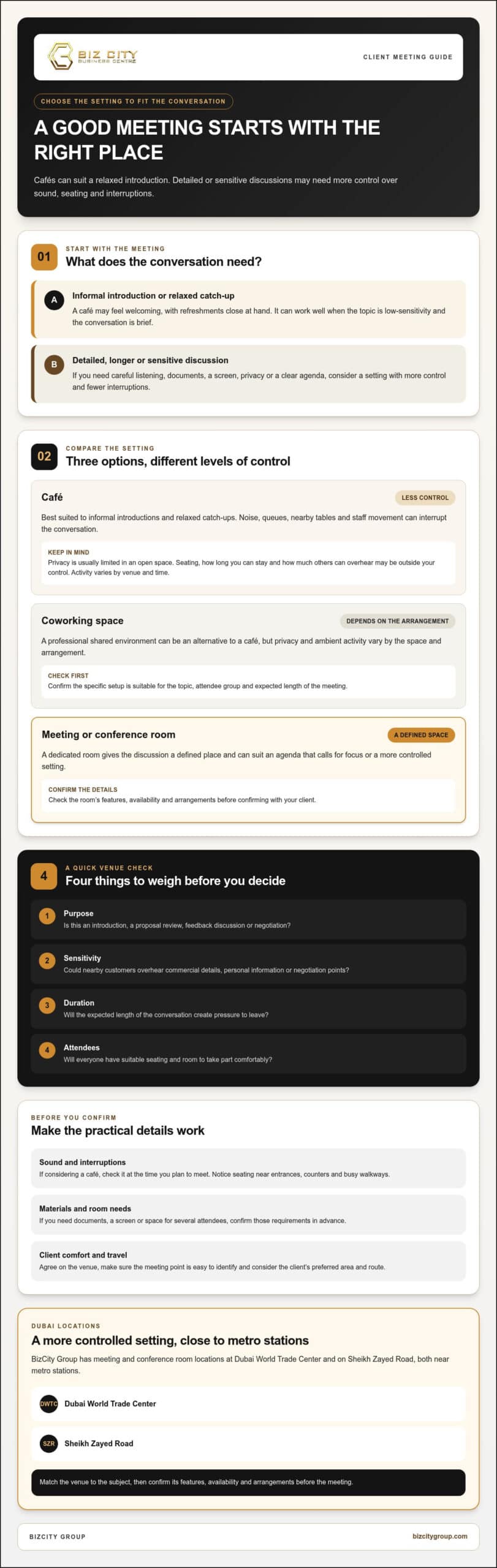
Choose the venue to support the conversation, not to set its pace. Before suggesting a café, consider four things: the meeting’s purpose, how sensitive the subject is, how long you expect to talk and who will attend. A quick introductory conversation with one guest may suit an informal setting. A longer discussion with several attendees may need more space and fewer distractions.
The more confidential or detailed the discussion, the more control over the setting matters. If you’re reviewing feedback, negotiating terms or presenting a proposal, consider whether the conversation needs privacy and uninterrupted concentration. Problems with meeting clients in cafes often begin when the venue’s limitations conflict with what the meeting requires.
Match the venue to the meeting’s purpose
A brief introduction about a low sensitivity topic can work well over coffee, especially if neither person needs to refer to materials. A detailed presentation or negotiation is different. Check whether you’ll need documents, a screen or a setting where everyone can follow the discussion without interruption. Confirm any practical room requirements in advance rather than assuming a venue can provide them.
Keep the decision proportionate. There’s no need to make a short, informal catch-up feel overly formal. But if the conversation has a clear agenda, several attendees or sensitive details, choose a setting that gives the discussion room to proceed at a comfortable pace.
Check practical details before inviting the client
Agree on the venue with your client instead of surprising them with a location. Check that the meeting point is easy to identify, seating is likely to suit the group and the expected duration won’t create pressure to leave. Consider crowd levels at the time you plan to meet, not just how busy the venue tends to feel in general.
Travel is part of the experience. In Dubai, ask which area is convenient for your client and consider proximity to Dubai Metro alongside their route. BizCity Group has locations near metro stations at Dubai World Trade Center and on Sheikh Zayed Road. If a more controlled setting fits the agenda, you can also explore meeting room options, checking the room’s features, availability and arrangements before confirming.
Use a simple check-in before settling on a café: confirm the purpose, privacy needs, likely duration and attendee preferences. That way, the setting supports the meeting rather than forcing either person to adapt to it.
Café, coworking space, or meeting room: compare the options
The best venue depends on how much structure the conversation needs. A café may be convenient, a coworking space can provide a professional shared environment, and a dedicated meeting room can give the discussion a defined place to happen. Conditions vary by venue, so use this comparison as a starting point and confirm the specific arrangement before inviting your client.
| Setting | Privacy | Ambient activity | Formality and control |
|---|---|---|---|
| Café | Usually limited in an open space | Depends on the venue and time | Informal, with less control over seating and interruptions |
| Coworking space | Varies by the space and arrangement | Shared environment, activity can vary | Professional setting, with control depending on what you book |
| Dedicated meeting room | A defined room can suit more private discussions | Less exposed to general public activity, depending on the venue | More structured, with arrangements to confirm in advance |
When a café is still a reasonable choice
A café can suit a brief, informal meeting about topics that aren’t sensitive, provided the location works for both people and the expected duration feels manageable. It’s a practical choice for a first introduction or a short catch-up. Have a backup in mind, though. If the café is crowded or the discussion turns to more detailed matters, be ready to suggest another setting rather than trying to force the conversation to continue.
When a professional workspace is a better fit
A dedicated meeting room offers a defined setting for a focused discussion, while coworking may suit collaborative work when a shared professional environment is appropriate. Neither option guarantees quiet or privacy in every arrangement, so confirm what the space provides and what access involves. BizCity Group offers meeting rooms and coworking spaces in Dubai, including locations near Dubai Metro. Explore BizCity Group workspaces.
Problems with meeting clients in cafes are less about the venue itself than a mismatch between the setting and the conversation. If focus or discretion matters, compare the available arrangements before deciding. That small check can help you choose a space that supports the meeting without making it feel unnecessarily formal.
Prepare the venue and conversation for a productive client meeting
A well planned meeting starts before you sit down. Confirm the purpose, who’s attending, where you’ll meet, how long you expect to talk and what you’ll need to bring. These details help you spot a mismatch early, such as a café that suits a short introduction but not a discussion that relies on documents, a screen or privacy.
Use this quick pre meeting check:
- Share the meeting purpose and approximate duration.
- Confirm attendees and ask about accessibility, privacy or travel preferences.
- Send a clear location and meeting point, after checking the venue’s current details.
- List any documents or technology you’ll need, then confirm whether the setting can support them.
- Check the venue beforehand if noise, seating or privacy could affect the discussion.
Set expectations with the client before the meeting
Give your guest enough context to decide whether the proposed venue works for them. For example, say that you’re planning a brief introductory conversation, or explain that you’ll be reviewing a detailed proposal. Invite them to flag any preferences around accessibility, privacy or travel. In Dubai, consider the client’s route and a meeting point that’s easy to identify. Verify the location before sharing it, especially if the venue has more than one entrance or branch.
Clarity avoids awkward surprises. It also lets you choose a different setting before the client has already made the trip.
Keep the discussion focused once you meet
On arrival, choose seating that makes it easy to hear one another and keeps papers or screens from being visible to nearby guests. Keep the agenda concise, and hold back confidential details if the setting doesn’t feel appropriate. These choices can reduce some problems with meeting clients in cafes, but they can’t compensate for a venue that’s too busy or exposed.
If conditions aren’t suitable, acknowledge the issue without blaming the café or your guest. You might say, “It’s busier than expected here. Shall we move somewhere quieter, or reschedule the detailed part of our discussion?” Offer a practical alternative and let the client respond. For a more defined setting, consider BizCity Group meeting rooms in Dubai. Check the room’s features, availability and arrangements before confirming.
Good preparation leaves room to adapt. Choose a setting that helps both people take part comfortably, then adjust the plan if the reality doesn’t match what you expected.
Choose a suitable Dubai meeting space when a café is not enough
A café can be a comfortable choice for a casual introduction, but a more important or privacy sensitive discussion may call for a defined setting. A dedicated meeting room gives you a place intended for the meeting, rather than asking the conversation to fit around café activity. Match the venue to the stakes, the topics you need to cover and the level of privacy your client expects. The right choice should help both of you take part without adding unnecessary formality.
Consider location and access in Dubai
Convenience matters for your guest as well as for you. BizCity Group has locations in Dubai World Trade Center and on Sheikh Zayed Road, near metro stations. Consider which location best suits your client’s route, and confirm the exact venue and access details before setting the meeting. Don’t assume a familiar building name is enough: share a clear meeting point and check that the details are current. This preparation helps the arrival feel straightforward.
Explore meeting rooms that fit the discussion
A meeting room may suit a focused review, a formal presentation or a conversation where privacy is important. BizCity Group offers meeting rooms and conference rooms in Dubai. Before arranging one, check the current room details directly and confirm that the setting is appropriate for your group, discussion and any materials you plan to use. Features, availability and access arrangements can vary, so clarify them rather than assuming they are included.
For a shorter or more collaborative session, consider which workspace arrangement best matches the conversation. The aim isn’t to make every client meeting formal. It’s to avoid problems with meeting clients in cafes when the discussion needs more focus or discretion than a public setting can provide.
Review the options and confirm the details that matter before inviting your client: Explore meeting spaces in Dubai.
Choose a setting that supports the conversation
Problems with meeting clients in cafes usually come down to fit: noise, limited privacy or a setting that doesn’t suit the meeting’s purpose. A café can still work for an informal catch-up, while a sensitive discussion, detailed review or longer conversation may call for a more controlled space. Confirm the purpose, attendees and practical requirements before you choose.
BizCity Group offers meeting rooms, conference rooms and coworking spaces in Dubai, with locations at Dubai World Trade Center and on Sheikh Zayed Road, near metro stations. Check the current room details and access arrangements to see whether an option suits your discussion and your client’s route.
Explore BizCity Group meeting spaces in Dubai and choose a setting that lets you give the conversation your full attention. A thoughtful venue choice can help your next client meeting feel focused, comfortable and well prepared.
Frequently Asked Questions
What are the main problems with meeting clients in cafés?
The main problems are noise, limited privacy, uncertain seating and interruptions. Music or nearby conversations can make it harder to hear, while queues and busy tables may break the discussion’s flow. For sensitive topics, an open setting can also leave you unsure who might overhear. These issues don’t affect every café or meeting equally, so weigh them against the conversation’s purpose, expected length and level of detail.
Is it unprofessional to meet a client in a café?
No. A café can be appropriate for an informal introduction or a short conversation about topics that aren’t sensitive. Professionalism depends more on choosing a setting that suits the meeting and arriving prepared than on choosing a prestigious venue. Consider whether your guest will be comfortable, able to hear you and free to participate without feeling rushed. If the discussion needs focus or discretion, choose a more controlled setting.
Can you discuss confidential business matters in a café?
It’s better to avoid discussing confidential details in an open café, where nearby customers may overhear or see documents. If a sensitive subject comes up, keep the conversation general and suggest moving it to a more private setting. For a planned discussion involving confidential information, arrange a suitable meeting room in advance and confirm that its setting meets your requirements.
What is a good alternative to meeting a client in a café?
A meeting room can be a practical alternative for a focused, formal or privacy sensitive conversation. A coworking space may suit collaborative work, depending on the arrangement and level of privacy available. In Dubai, BizCity Group offers meeting rooms, conference rooms and coworking spaces, with locations in Dubai World Trade Center and on Sheikh Zayed Road near metro stations. Check current room details, access and suitability before confirming.
How do I tell a client I would prefer a meeting room?
Frame the change around the conversation, not a criticism of the café. You could say, “As we’ll be reviewing some detailed information, would you be comfortable meeting in a meeting room instead?” Share the location and expected duration, then ask about their travel or accessibility preferences. This keeps the request courteous and gives your client a clear reason for the alternative.
What should I check before choosing a café for a client meeting?
Check the café at the time you plan to meet, since crowd levels and noise can vary. Consider whether there’s suitable seating, a clear meeting point and enough flexibility for the expected duration. Think about the client’s route and preferences, too. If you’ll need to discuss sensitive details or use documents, confirm that the setting is appropriate, or choose a more private venue.


